Friday, September 15, 2017

Seasons of the Gut

By: Sergio Barragan

Honey is a typical food source for the Hadza during the wet season. Figure taken from http://www.cnn.com/2017/07/05/health/hunter-gatherer-diet-tanzania-the-conversation/index.html 

The Hadza are a group of hunter-gatherers from Tanzania. Their lifestyle cycles between foraging in the wet season to hunting in the dry season. This way of life has a marked effect on their diet and has produced a seasonal change in their gut microbes that have piqued the interest of scientists such as Smits and his team. The scientists collected fecal samples from 188 individuals over a 12-month span. The samples were genetically sequenced to identify what microbes live in their gut and how diverse they are. Studies showed that a more diverse microbial community emerged in the dry season compared to the wet season where some species could no longer be detected. The results were also compared to the gut microbes of people from different countries. An interesting finding was that the more urbanized populations had a lower diversity of microbes (a lot of which are missing compared to those found in the Hadza) and no cyclic tendencies of dormancy and emergence. Smits and his colleagues also found that Hadza microbes had a lower level of antibiotic resistance genes than the general population of civilized countries.

This leaves us with a series of interesting questions. What will happen to the Hadza gut microbes when introduced to modern medicine? Will they lose some microbes due to a change in diet or lifestyle? If so, what sorts of microbes have we lost as a side effect of modernization?

Citation: Smits SA, Leach J, Sonnenburg ED, Gonzalez CG, Lichtman JS, Reid G, et al. (2017). Seasonal cycling in the gut micobiome of the Hadza hunter-gatherers of Tanzania. Science. 357: (802-806). doi: 10.1126/science.aan483

Incurable Disorder Seeks Possible Coping Treatment

By: Jose Rodriguez


Cystic Fibrosis is an inherited disorder that affects the cells that produce mucus, sweat, and digestive fluids. It causes them to become thick and sticky, which in turn block and clog the airways of the lungs. This blockage then keeps bacteria in the lungs which can then lead to infection. Unfortunately, this disorder is incurable and only treatment can reduce potential problems. Pseudomonas aeruginosa is a pathogen that becomes prevalent in the lungs during Cystic Fibrosis. In a study done by Chatterjee and colleagues, the group attempted to see if P. aeruginosa would be inhibited by environmental pseudomonad strains that dominated competition. Several environmental pseudomonad isolates displayed antagonistic activity towards P. aeruginosa and other strains even created factors that have the ability inhibit P. aeruginosa. These environmental pseudomonads exhibit the capacity to bring fourth new antibiotics. Further discovery and understanding of these antagonistic processes can help reveal superior treatment methods for patients of Cystic Fibrosis. 


Figure 1. Displays a plate assay, utilized to confirm and observe antagonistic activity between Pseudomonad isolates.

Original Article: Chatterjee P, Davis E, Yu F, James S, Wildschutte JH, Wiegmann DD, Sherman DH, McKay RM, LiPuma JJ, WildschutteH. 2017. Environmental pseudomonads inhibit cystic fibrosis patient-derived Pseudomonas aeruginosa. Appl Environ Microbiol 83:02701-16. https://doi.org/10.1128/AEM.02701-16. 

Thursday, September 14, 2017

The Great Reef Killer


By: Krystal Perez 


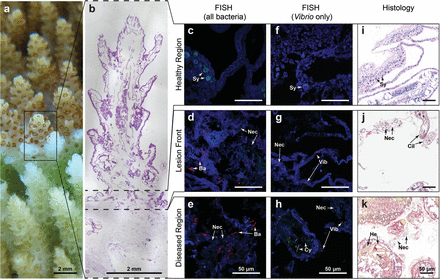
The vibrant coral reefs in the ocean are experiencing a phenomenon that is unusual to the eye. A disease known as White Syndrome (WSs) causes coral to lose their tissue, their color, and ultimately causing death. A study ran by Pollock FJ and colleagues hoped to differentiate different types of white syndrome diseases, although they were not able to determine the cause of the WSs, they were able to identify different methods used as building blocks in the hopes of  future discoveries that have to do with White syndorme. Histology exams showed no signs of WS characteristics in either healthy and diseased coral. Vibrio bacteria was used as an agent that was related to loss off tissue, which resulted in WS disproving Vibrio relationship. Rhodobacteraceae, a type of proteobacteria, showed to be a commonality in the samples that were diseased and healthy. It was concluded that more coral studies about Rhodobacteriaceae should be done in order to better understand the purpose for the bacteria. Studies like the these could lead to new discoveries that could be implemented in the preservation of our planet.


                          Figure 1. Shows the caparison between a healthy lesion and a white syndrome diseased lesion, and FISH staining comparisons between all bacteria, and that of Vibro sp. bacteria. Histology is also demonstrated. 


Original Article: 

Pollock FJ, Wada N, Torda G, Willis BL, Bourne DG. 2017. White syndrome-affected corals have a distinct microbiome at disease lesion fronts. Appl Environ Microbiol 83:e02799-16. https://doi.org/10.1128/AEM.02799-16.


The Yenisei River and its Radioactive Particles


By: Mariel Morales

Figure 1. Map of the locatio where the Mining-and-Chemical Combine (MCC) radiochemical plant is located in proximity to the Yenisei River. This shows how the plant has easy access to the river in regards to spilling chemical wastes.  Figure taken from Bolsunovsky et al. 2017

Whether it is near the plains, grasslands, or a body of water, radiochemical plants can reside in any area and contaminate whatever it reaches. A study conducted by Bolsunovsky and colleagues found that there was fuel contamination present in the Yenisei River. This contamination was in the form of radioactive particles such as, Cesium, Plutonium, and Europium. These particles where created from the Mining-and-Chemical Combine radiochemical plant (MCC). Amazingly, there has been no other Europium particles found anywhere in the world. After the data was carefully characterized, the researchers later found out that the corrosion of the reactor’s cooling system and damaged compensating rods caused the contamination. They also discovered that the ingestion, inhalation, and direct skin contact of the particles cause direct effects to the organism which received surface contamination. Weathering by the radionuclides being transferred by the ecosystem causes long term effects.Without these types of studies, there will always be misconceptions in regards to the information that is presented to the public. The importance of understanding the data that was collected and how these radioactive particles can have negative environmental effects is imperative.


Bolsunovsky A, Melgunov M, Chugevskii A, Lind OC, and Salbu B (2017). Unique diversity of radioactive particles found in the Yenise River floodplain. Nature 7: 1-10.

A Bit Fishy In the Head


Plastic particles have become a widespread problem throughout the environment and have been found to affect many wildlife through digestion or entanglement. One alarming problem that eludes many is the pieces of plastic that we are unable to see, called nanoparticles. These particles are an even more alarming threat due to being able to cross biological barriers and also be eaten by microscopic organisms. This directly poses a great threat to all marine life since. In a study done by Mattson et al., they were examining these plastic nanoparticles on the behavior of fish. This was done by administering different sizes of nanoparticles in conjunction with algae for a zooplanktonic species called Daphnia magna. The top consumer which was Crucian carp (Carassius carassius) which fed on the algae. This allowed the researchers to observe the effects of these nanoparticles on fishes behavior since the nanoparticles would be absorbed into the carps’ bloodstream. Through this study the researchers were able to discover that there was a shorter lifespan for D. magna that consumed the nanoparticles of plastic, compared to the control which did not. C. carassius began to display unusual behaviors when compared to the control. This included factors such as feeding time and fish exploration after feeding. A CytoViva Hyperspectral Imaging System was used and there were indeed nanoparticles of plastic in the brains of C. carassius. This goes to show that we may be starting to affect the environment in more ways than we could have imagined.
These graphs demonstrate the fishes exposed to plastic nanoparticles at different sizes. They are compared against each other in order to determine how much the behaviors of each deviates from the control.

Article From:
Tommy C., Lars-Amders H., Elyse J., Sara L., Anders M., Karin M. Brain damage and behavioral disorders in fish induced by plastic nanoparticles delivered through the food chain. Nature 2017; e-pub ahead of print 13 September 2017, doi: 10.1038/s41598-017-10813-0


Is the Consumption of Salads Damaging your Health?

By: Diana Carrizales

It is not uncommon to directly correlate the consumption of salads with a healthy lifestyle. That is why it may come as a surprise to many that salads are now ranked as the second most common source of outbreaks of food borne illness. This is because salad leaves, particularly lettuce and spinach, have a high probability of being infected by enteric pathogens due to their minimal processing, raw ingestion, and high-water content. A research carried out by Koukkidis and colleagues showed that there is a significant increase in the probability of bagged salad leaves acquiring Salmonella. This occurs as the lettuce leaves become physically damaged and release juices. These juices are what allow Salmonella to grow, colonize, and linger in the salad leaves. Even though the growth of Salmonella was higher at non-refrigeration temperatures, leaves that were refrigerated over five days also displayed growth. Next time you reach for your bagged salad leaves, be aware that they may pose a serious infection risk.

Panels A and B show typical pictures of a salad microbiota. Panel C displays light microscopy images of salmonella of salad bag plastic in water in the absence and presence of spinach juice. Panel D shows blue light microscopy of salmonella incubated in water in the presence and absence of spinach juice. Figure from Koukkidis et al. 2017

Original article:
Koukkidis G, Haigh R, Allcock N, Jordan S, Freestone P. 2017. Salad leaf juices enhance Salmonella growth, colonization of fresh produce, and virulence. Appl Environ Microbiol 83:e02416-16

Please Turn the Lights Off

By: Blanca Ortega

Microbial communities are found almost everywhere. Interestingly polar glaciers are not the exception. Microbes can be found in the Antarctic in mainly three places: ice surface, cryoconite holes and in cryolakes. Since the Antarctic is completely covered by an ice lid the Photosynthetically Available Radiation (PAR) is limited. A study carried out by Bagshaw and colleagues analyzed PAR as an important control on primary production in cryoconite and cryolakes ecosystems. The researchers settled up incubators in the laboratory for the study of both ecosystems (cryoconite and cryolakes). The incubator containing the cryolakes perfectly resembled the original environment. It was exposed to an increased amount of light. The increment of light directed to an increased efficiency of primary production. In another scenario, the researchers increased the light to levels in which they are adapted to receive on the ice surface, but without the protection that resembled the ice lid. The efficiency decreased dramatically and the photophysiology showed that the communities suffered light stress. On the other hand, cryoconite communities are not covered by an ice lid, but the organisms also presented stress to the light. This means that on the natural environment of cryoconites the communities manage strategies to survive and protect themselves against photodamage. In essence, both communities are well adapted to low light levels.


Figure 1. Map showing the exact location where samples were collected for laboratory incubations. Figure taken from Bagshaw et al. 2016.

Elizabeth A. Bagshaw, Jemma L. Wadham, Martyn Tranter, Rupert Perkins, Alistair Morgan, Christopher J. Williamson, Andrew G. Fountain, Sean Fitzsimons, Ashley Dubnick; Response of Antarctic cryoconite microbial communities to light, FEMS Microbiology Ecology, Volume 92, Issue 6, 1 June 2016. fiw076, doi: 10.1093/femsec/fiw076